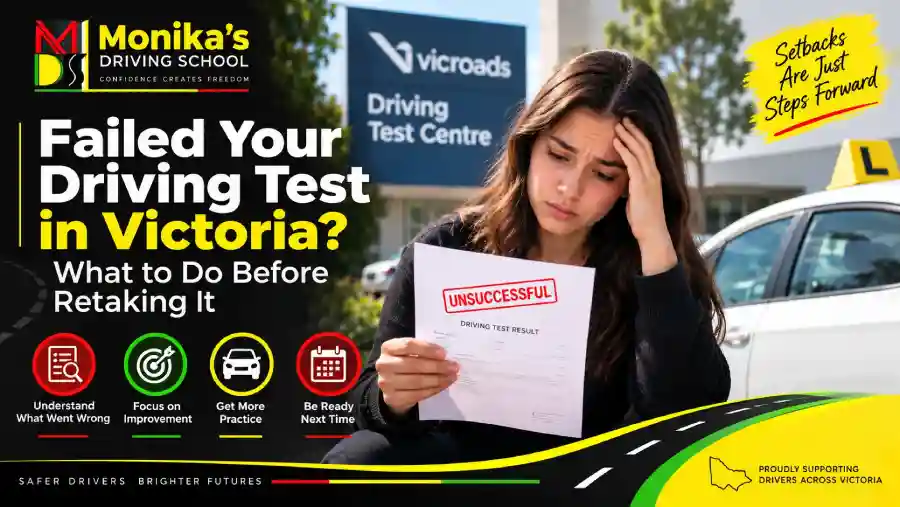
It’s one of the most frustrating experiences a learner driver can have. You’ve put in the hours. You’ve done lesson after lesson. Your supervisor says you’re doing fine. Yet on test day, you walk out without a P plate — again.
If this sounds familiar, you’re not alone. Many learners in Victoria complete their full 120 logbook hours and take dozens of professional lessons, yet still struggle to pass. The problem isn’t always a lack of driving time. More often, it comes down to how those hours were spent, what habits formed along the way, and what happens mentally when the examiner gets in the car.
Let’s break down the real reasons learners fail even after extensive practice — and what you can actually do about it.

1. They’ve Practised Habits, Not Skills
This is the single biggest issue we see. Logging 120 hours sounds impressive, but if the majority of those hours involved driving the same quiet streets near home, with a parent in the passenger seat who never corrected anything, those hours may have cemented poor habits rather than built genuine competence.
Practice makes permanent — not perfect. If you’ve been consistently checking your mirrors incorrectly, braking too late, or holding the steering wheel the wrong way for months, those patterns become deeply ingrained. And on test day, when nerves kick in, you revert to exactly those ingrained behaviours.
This is why professional instruction needs to run throughout your learning — not just at the beginning. An instructor’s job isn’t simply to teach you the basics; it’s to correct the errors that form over time, and that supervised drivers with no formal training often can’t spot. Read our guide on the most common mistakes beginner drivers make during driving lessons to see if any feel familiar.
2. They Haven’t Driven in Enough Different Conditions
Comfort on familiar roads is not the same as driving competence. Many learners spend the bulk of their hours in one or two areas — usually close to home — and rarely venture into genuinely challenging environments.
The VicRoads driving test is designed to assess how you handle a range of real traffic situations. If you’ve never practised:
- Busy intersections during peak hour
- Merging onto higher-speed roads
- Roundabouts with multiple lanes
- Driving in rain or reduced visibility
- City driving with trams, hook turns, and bike lanes
…then encountering any of these on test day can throw you completely, regardless of how many hours you have in your logbook.
Varying your practice environments is essential. Our tips for driving confidently in Melbourne traffic and our guide to quiet roads for beginner drivers can help you build up progressively across different conditions.
3. Test Anxiety Is Sabotaging Their Performance
You can be a genuinely capable driver and still fail because of anxiety. Test anxiety is real, physiological, and extremely common among learner drivers — and it’s separate from your actual driving ability.
When anxiety spikes, your working memory is affected. You forget to check the mirrors at the right moments. You hesitate at intersections you’d normally handle smoothly. Your hands grip the wheel too tightly, and your steering becomes less fluid. You second-guess decisions you’ve made dozens of times confidently before.
What’s worse, anxiety often compounds over time — especially if you’ve already failed once. The pressure of “I can’t fail again” creates exactly the kind of mental state that leads to more errors.
Managing test anxiety requires deliberate preparation, not just more driving hours. Our posts on overcoming driving anxiety before your test and driving tips for nervous drivers offer practical strategies you can start using well before test day — not just on the morning of.
4. They’re Not Practising in Test Conditions
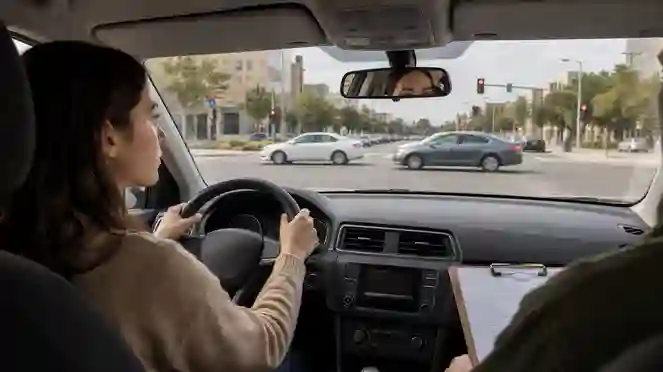
There’s a significant difference between driving when you’re relaxed and comfortable and driving when someone is formally evaluating every decision you make. Most supervised practice sessions have no resemblance to actual test conditions — there’s no examiner, no clipboard, no formal instructions, and usually no real pressure.
This gap matters. Learners who have never practised under simulated test conditions often experience a genuine shock when they sit the real thing. The examiner’s silence, the formal instructions, the knowledge that every action is being recorded — all of it feels alien.
The solution is to deliberately replicate test conditions in your practice:
- Ask your supervisor to act as an examiner and give formal instructions rather than casual conversation
- Drive a planned route without stopping or getting feedback until the end
- Have a friend or sibling sit in the back without talking, mimicking the examiner’s presence
- Book a lesson specifically structured as a mock test
Our mock driving test checklist for beginners and practice driving test checklist are designed exactly for this purpose — use them before your test date, not after.
5. They Don’t Know Why They Failed Last Time
Failing a driving test without understanding why you failed is a recipe for failing again. Yet many learners walk out of an unsuccessful test without a clear picture of what went wrong, chalk it up to nerves, and book the next test without changing anything.
VicRoads examiners provide feedback, but it can be brief and generic. If you don’t have a professional instructor helping you interpret that feedback and address the specific issues identified, you’re likely to repeat the same errors.
The most common reasons for failing the driving test are more specific than most learners realise — it’s often not just “you were nervous” but particular observation failures, incorrect positioning, or hesitation at specific types of intersections. Understanding the exact fault category and addressing it directly is the only way to improve.
Also worth knowing: some errors are instant fails regardless of everything else you did correctly. Make sure you’re clear on what constitutes an instant fail on the Victoria driving test so you know exactly what to never do, under any circumstances.
6. Their Lessons Weren’t Consistent Enough
Sporadic lessons — one every few weeks, or a burst of lessons followed by a long gap — are far less effective than regular, consistent practice. Driving skills are built through repetition and refinement over time. When there are long gaps between lessons, skills fade, bad habits creep back in, and instructors spend part of each session re-covering old ground rather than building on it.
This is a particularly common issue for learners who are balancing school, work, or study commitments. Life gets busy and lessons get pushed back. Before long, six weeks have passed since the last session.
We’ve written in detail about why consistency matters in driving lessons — it’s one of the most underrated factors in how quickly and effectively a learner progresses. If your schedule is tight, even one lesson per week maintained consistently will outperform two lessons one week and nothing for the next month.
7. They Stopped Taking Professional Lessons Too Early
Many learners treat professional instruction as something for the beginning stages only — get the basics right, then rely on supervised practice with family for the rest of the hours. This approach misses something important.
The early lessons cover the fundamentals. But more advanced skills — smooth hazard perception, confident decision-making at complex intersections, reading traffic flow, managing higher speeds — require a different level of feedback and coaching that most supervisors simply can’t provide.
If you’re wondering whether you might need more time with a professional before testing, our post on the signs you need more driving lessons in Melbourne is worth an honest read. And if you’re unsure whether you’re actually test-ready, check the 5 signs you are ready for your driving test — not feeling ready is important data, not something to push through.
8. They Haven’t Driven the Actual Test Routes
This surprises many learners, but the VicRoads test follows predictable routes from each test centre. Knowing those routes — and having practised them — gives you a significant advantage. You’ll know where the tricky intersections are, where you’re likely to be asked to change lanes, and where to expect roundabouts or school zones.
Learners who test at Hoppers Crossing or Werribee, for example, can familiarise themselves with the likely test roads in advance. Our breakdown of driving test routes for Hoppers Crossing and Werribee is one example of how this kind of preparation pays off. The same logic applies to every test centre across Melbourne — knowing the terrain removes one significant source of surprise on the day.
9. They Underestimated What the Test Actually Requires
The VicRoads driving test is not a simple “can you drive from A to B” assessment. It’s a structured evaluation of your observation habits, decision-making, positioning, speed management, and hazard response — measured consistently across the entire route.
Many learners prepare based on a vague understanding of what the test involves rather than a precise knowledge of what examiners are actually looking for. Understanding how driving examiners evaluate learner drivers changes how you prepare — you start focusing on the right things rather than practising what already feels comfortable.
What to Do If You’ve Failed More Than Once?
First: failing the driving test is not a reflection of your intelligence or capability. It means there are specific gaps between where your driving is now and what the test requires. Those gaps are fixable.
Here’s what to do:
Get a professional debrief: Book a lesson specifically to debrief the test. Go through the examiner’s feedback with your instructor and identify the exact fault categories — not just broad themes.
Don’t rush to rebook: It’s tempting to rebook immediately after failing, but if you haven’t addressed the underlying issues, you’re likely to repeat the result. Understand first what to do if you fail your driving test and whether retaking immediately is the right call for your situation.
Focus on test preparation lessons: Our VicRoads test prep lessons are structured specifically around the skills and habits examiners assess. These are different from standard lessons — they’re targeted, pressure-tested, and designed to close the gaps that lead to failure.
Build toward passing the first time: Our pass first time programme gives learners a structured pathway that addresses all of the common failure points from the ground up.
Conclusion
Hours alone don’t produce good drivers. Quality of practice, consistency of instruction, the right preparation for test conditions, and honest self-assessment all matter just as much — arguably more — than the raw number of lessons completed.
If you’ve taken many lessons and still haven’t passed, the answer isn’t simply “more of the same.” It’s a targeted look at what’s actually going wrong, and a deliberate plan to fix it.
That’s exactly what Monika’s Driving School is here to help with. Get in touch with us to discuss where you are in your learning journey and how we can help you get across the line.