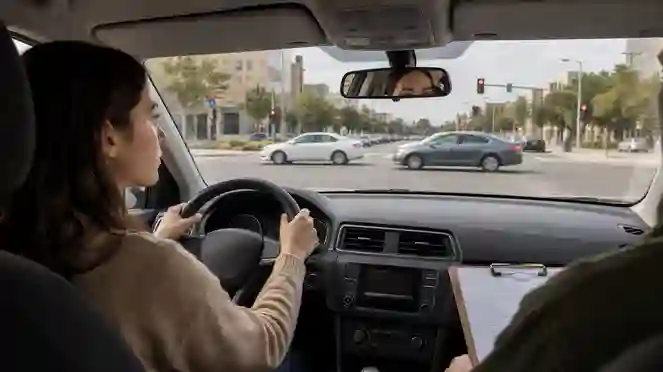
Yes, you can fail a VicRoads driving test for hesitating at an intersection—but only under specific conditions. A brief pause to assess is safe driving. Persistent hesitation or hesitation under clear conditions is a fault. This guide explains the distinction, why it matters on test day, and how to eliminate hesitation before your test.
What VicRoads Actually Means by “Hesitation”?
VicRoads examiners aren’t penalising caution. They’re assessing whether you’re making timely, appropriate decisions. The difference lies in these four criteria:
1. Judgment
Does your hesitation reflect genuine uncertainty (acceptable) or indecision under clear conditions (a fault)?
A safe pause: You’re at a red light, a pedestrian steps into view, you pause to confirm they’re actually crossing. This is good.
A hesitation fault: You’re at a green light with clear visibility, no pedestrians, no vehicles, and you hesitate for 2-3 seconds before proceeding. This signals poor judgment to the examiner.
2. Safety
Is your hesitation keeping you safe, or is it creating risk for other road users?
Safe hesitation: You slow down to assess visibility at a partially obscured intersection. You’re gathering information to make a safe decision.
Unsafe hesitation: You stop abruptly and unexpectedly in the traffic lane because you’re unsure whether to proceed. Now the driver behind you is at risk.
3. Progression
Are you advancing through the intersection appropriately, or are you blocking traffic unnecessarily?
Acceptable pause: You’re waiting for an oncoming turning vehicle to clear your path. Once it does, you proceed smoothly.
A fault: You wait 3+ seconds after a turning vehicle clears, creating a gap that other traffic could use. This signals indecision, not safety.
4. Control
Is your hesitation a decision point or a loss of control?
Control: You’ve identified a reason to slow or stop (oncoming traffic), you execute it smoothly, and you proceed once conditions allow.
Loss of control: Your speed wavers, you brake inconsistently, or you stop in an inappropriate location because you’re uncertain.
The VicRoads test criteria combine these four elements. A hesitation fault is assessed under the “Judgement” category, specifically when an examiner believes you’ve delayed progression without a safety-justified reason.
Why Learners Hesitate at Intersections?
Hesitation isn’t about being cautious. It’s about processing speed. Experienced drivers gather information faster, decide faster, and execute faster. They’re not braver; they’re more automatic.
Learners hesitate for three core reasons:
1. Slow Environmental Scanning
You’re still learning where to look. Your eyes follow a deliberate sequence: mirrors, road ahead, pedestrians, traffic lights, oncoming vehicles. An experienced driver does this in 1-2 seconds. A learner might need 3-4 seconds, and the pause becomes visible as hesitation.
2. Ambiguous Right-of-Way
You’re uncertain whether you actually have right-of-way. Multi-lane roundabouts, complex traffic light sequences, pedestrian movements, and unusual intersection geometry create genuine ambiguity for learners. This uncertainty causes hesitation.
3. Anxiety or Confidence Gaps
Some learners hesitate because they’re nervous, not because they lack judgment. Anxiety narrows attention, slows decision-making, and creates internal conflict between “go” and “stop” impulses. This manifests as visible hesitation.
The solution to each is different. If your hesitation is slow scanning, practice accelerates your visual routine. If it’s ambiguous right-of-way, targeted scenario training reduces ambiguity. If it’s anxiety, confidence-building and exposure therapy address the root.
The VicRoads Test: Where Hesitation Gets Marked as a Fault
VicRoads examiners use a structured marking system. Hesitation is assessed within the “Judgement” fault category. A single hesitation fault typically doesn’t result in a fail—you’d accumulate faults across multiple driving areas. However, multiple hesitation instances across a test route can add up to a fail, especially if combined with other faults.
What Triggers a Hesitation Mark?
- Unexplained pauses at intersections (2+ seconds with no visible hazard)
- Delayed progression when conditions are clear
- Inconsistent speed suggesting internal indecision
- Blocking traffic unnecessarily due to uncertainty
- Multiple hesitation instances at different intersections
What Does NOT Get Marked?
- Brief pauses to confirm pedestrian movements
- Slowing to improve visibility
- Waiting for oncoming traffic to clear
- Cautious approach to unfamiliar intersection types
- Pauses justified by actual hazards or rule uncertainty
In practice: If you hesitate once at a difficult intersection (complex roundabout, high pedestrian traffic), you’ll likely escape a mark. If you hesitate at every green light, or at multiple simple intersections, the examiner will mark hesitation as a recurring fault.
How to Practice Intersection Confidence
Confidence at intersections isn’t about aggression. It’s about throughput—your ability to gather information quickly, make a decision, and execute smoothly.
Graduated Exposure
Build experience across intersection types in this order:
- Simple T-intersections with clear right-of-way
- Traffic-light controlled intersections
- Roundabouts
- Complex multi-lane intersections
- Peak-hour conditions
Each step adds a layer of cognitive demand.
Externalise Your Decision Process
As you approach each intersection in practice, narrate your thinking aloud to your instructor. “I see a green light, no pedestrians, no turning vehicles, I’m going.” This builds a repeatable mental routine. When test day arrives, you follow the script rather than inventing decisions under pressure.
Separate Observation from Decision
Spend one second observing (scanning mirrors, checking the environment). Spend 0.5 seconds deciding (yes/no). Then spend one second executing (smooth acceleration, confident trajectory). This timing structure prevents the “pause-pause-pause” pattern that reads as hesitation.
Test Familiar Territory First
Most of your practice should be on roads you know. A familiar route removes environmental unpredictability, letting you focus on refining your intersection technique. Your learner phase is the time to build automaticity through repetition.
High-Volume Intersection Practice
Get reps. If you’re practicing for a VicRoads test in Melbourne, aim for 15-20 intersection approaches per lesson, not 2-3. Volume builds pattern recognition, which speeds up decision-making.
Common Intersection Scenarios from Test Routes
Melbourne’s VicRoads test routes include several high-hesitation zones. Preparing for these reduces anxiety and prevents hesitation:
Multi-Lane Roundabouts
Werribee and Footscray test routes include multi-lane roundabouts. Hesitation here happens because learners aren’t sure which lane to exit from or when to yield to circulating traffic. Practice until lane choice becomes automatic.
Peak-Hour Arterials
Routes on Bell Street or Docklands Drive test you under high-volume conditions. Hesitation from traffic intensity is common. Practice these conditions regularly so busy traffic feels normal, not threatening.
Pedestrian-Heavy Zones
City test routes include high pedestrian areas. Hesitation happens because pedestrian movements are unpredictable. The remedy: accept that you can’t predict pedestrians; you can only respond to their actual movement (are they stepping off or not?). Practicing in pedestrian zones until this feels automatic is key.
Slip Lanes and Complex Geometry
Some test routes include slip lanes or unusual intersection geometry. If you’ve only ever practiced simple T-intersections, encountering a slip lane on test day triggers caution. Familiarise yourself with all intersection types in advance.
The Role of Test Preparation Lessons
Specific preparation reduces hesitation on test day. A structured VicRoads test prep lesson focuses on the exact routes, traffic patterns, and intersection types you’ll encounter.
During prep lessons, your instructor identifies your specific hesitation triggers. Are you hesitating at all intersections, or only at complex ones? Only when turning right? Only in peak hour? Pinpointing the trigger lets you address it specifically rather than generalising (“I’m not confident at intersections”).
Test prep also exposes you to the examiner’s perspective. Instructors simulate examiner commentary and assessment, so you understand what’s being watched. This mental rehearsal reduces surprise and hesitation on the day.
If you’re within two weeks of your test, a last-minute test prep session focusing on intersection technique can meaningfully reduce hesitation faults.
Advanced Intersection Technique: Reading Ahead
Experienced drivers rarely hesitate at intersections because they’re not seeing each intersection as an isolated moment. They’re reading the sequence—predicting what’s coming before they arrive at the intersection.
Look Through the Intersection
As you approach, look past the immediate intersection to the next one. This contextual preview helps you anticipate traffic flow and required positioning.
Predict Vehicle Movements
As you scan for vehicles at an intersection, mentally predict where they’ll be by the time you reach it. A car turning right now will be clear of your path in 2 seconds. You can plan your entry around that prediction.
Chain Intersections
On a route with multiple intersections in quick succession (common on arterial roads), think of them as a chain. Your exit from one intersection determines your approach to the next. Planning this sequence prevents the herky-jerky pattern of pause-start-pause-start.
Use Road Structure
Lane markings, traffic signals, and road geometry aren’t random. They’re designed to communicate right-of-way and flow. Reading these cues (a single lane forcing a single direction, advance green lights, slip lanes) reduces ambiguity and hesitation.
Learners don’t need to master this immediately. But introducing this concept—thinking two intersections ahead—shifts hesitation from a fear response to a planning rhythm.
Nervous Driver Considerations
If hesitation at intersections is linked to general nervousness rather than a specific skill gap, the approach differs slightly. Nervous driver lessons are structured to build confidence through repeated exposure, positive reinforcement, and gradual progression into higher-stress environments.
For nervous learners, hesitation is often a symptom of anxiety rather than a lack of skill. The remedy combines technique training with anxiety management—breathing exercises, self-talk scripts, and deliberate exposure to feared scenarios until they become routine.
Many learners who hesitate are actually competent drivers who haven’t yet internalised their own competence. Test prep and confident instruction can shift this perception quickly.
Beyond the Test: Building Long-Term Intersection Confidence
The test is a snapshot. What matters more is the driving habit you’re building. Learning to approach intersections decisively, even when anxious, transfers to every drive for the rest of your life.
Hesitation at intersections tends to decrease naturally as you accumulate post-test experience. After 50 hours of solo driving, intersections that triggered pauses on your P-plate days feel routine. This isn’t because you’re suddenly braver; it’s because automaticity has increased and environmental unpredictability feels more predictable.
The goal isn’t to eliminate all hesitation—genuine uncertainty deserves a pause. The goal is to shrink the pause from 3 seconds to 0.3 seconds, and to ensure that when you do pause, it’s visible as deliberate assessment, not paralysis.
Key Takeaways
- Hesitation becomes a fault when it breaches judgment, safety, progression, or control criteria. A brief pause to assess is safe driving; repeated hesitation or hesitation under clear conditions is a fault.
- Speed of decision is the critical skill. Learners who hesitate are often slow at reading the environment, not lacking in caution. Practice accelerates perception.
- Intersection confidence is learned, not innate. Graduated exposure, repetition, and explicit decision-making routines build automaticity.
- Test prep targets hesitation reduction specifically. If you’re closer to test day, focused preparation on the routes and scenario types you’ll face can dramatically reduce hesitation faults.
- Nervousness and hesitation are linked but separate issues. If anxiety is driving hesitation, addressing the anxiety directly (rather than just technique) is essential.
The next time you approach an intersection on your learner phase, pause for a moment—but let that pause be a deliberate scan, not a freeze. Gather information, make a decision, and commit to it. That’s the rhythm examiners reward.